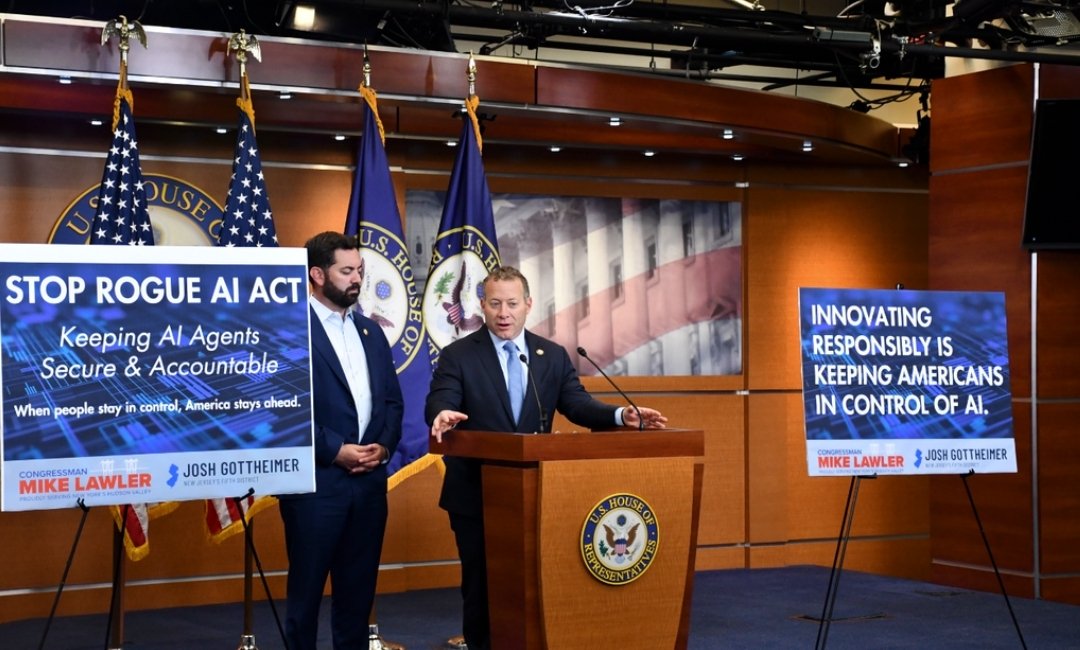
US Lawmakers Target Rogue AI With New Bipartisan Bill
WASHINGTON, DC-Two US lawmakers have introduced bipartisan legislation seeking national standards to identify, monitor and shut down potentially dangerous Artificial Intelligence (AI) agents operating inside government and corporate computer networks.
Representatives Josh Gottheimer (D-NJ), and Mike Lawler, (R-NY), said their ‘Stop Rogue AI Act’ would give organizations greater visibility over autonomous AI systems using their networks.
AI agents can perform tasks, make decisions and interact with computer systems with limited human involvement. The lawmakers said such agents could be activated by employees, embedded in third-party software or introduced by outside vendors without the organization knowing they were present.
The bill would direct the National Institute of Standards and Technology (NIST) to develop national standards, guidelines and best practices for discovering, verifying, monitoring and controlling AI agents.
“You can’t drive a car in this country without a license plate, without insurance, without some way for a cop — or the person you just rear-ended — to know who’s behind the wheel and who’s responsible,” Gottheimer said.
“AI agents right now don’t have any of that. Our bill puts a driver’s license on every AI agent operating in this country — so organizations can find every agent on their network, verify who built it, watch it in real time, and cut off its access the second something looks wrong,” he said.
“That means putting humans back in the driver’s seat. It’s time for Congress to get back to work and get this done,” Gottheimer added.
The lawmakers said organizations often lack a reliable method to determine how many unauthorized AI agents are working inside their systems, who created them or what information and functions they can access.
That lack of visibility could be particularly serious when the agents operate inside hospitals, utilities, government agencies or other networks handling sensitive information and essential services.
Lawler said the legislation was intended to establish safeguards without restricting the development of artificial intelligence.
“This isn’t about stopping AI or stifling innovation. It is about making sure we can safely deploy AI,” he said.
“A pause is not a safeguard. Some states have put a moratorium on the infrastructure that powers this technology. That does not invent a kill switch. It does not inventory the agents already on a hospital network or a utility system,” Lawler said.
“If the United States taps the brakes while others floor it, we do not get safer AI. We get someone else’s AI. We are not going to regulate ourselves into second place,” he added. (IANS)