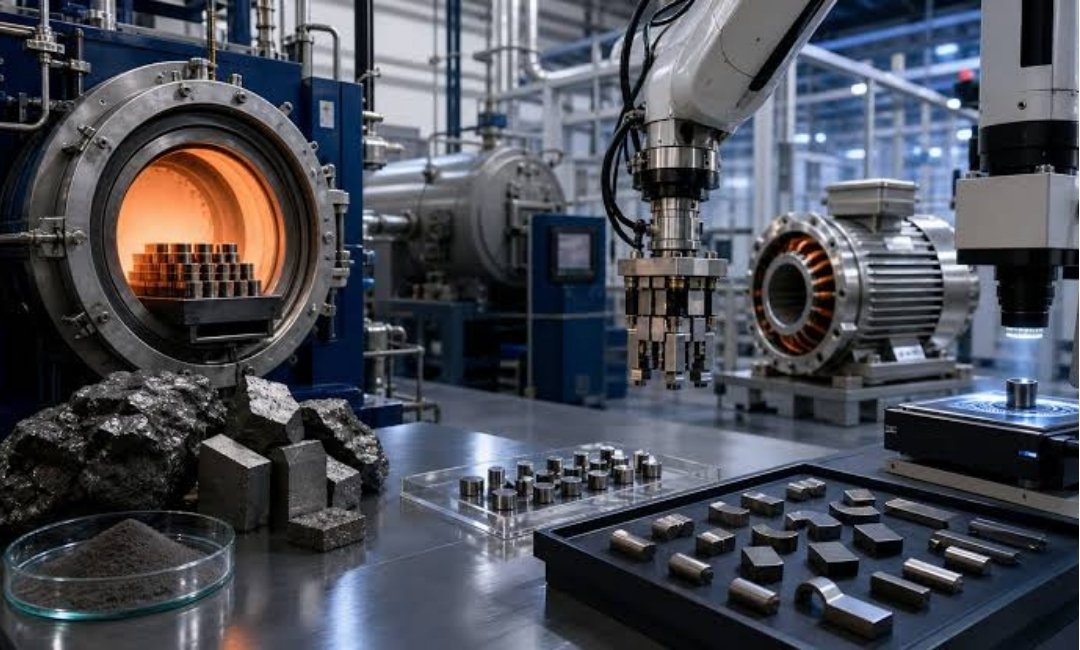
India Moves To Build Its Own Rare-Earth Magnet Industry
NEW DELHI — India has received 20 bids to build integrated rare-earth permanent magnet manufacturing facilities, as the government seeks to create an integrated chain stretching from NdPr oxide to finished magnets, a new report has said.
The report from Times Kuwait highlighted that India’s broader critical-mineral strategy increasingly focuses on value addition, processing and manufacturing rather than stopping at the extraction stage.
The strong response from bidders has given fresh momentum to a policy effort that goes beyond securing raw material to building the industrial capacity needed to convert India’s rare-earth resources into high-value products, the report said.
India’s $7.74 billion rare-earth permanent magnet scheme aims to create 6,000 metric tons per annum of integrated REPM manufacturing capacity in the country.
The Ministry of Heavy Industries invited proposals on March 20, 2026, and opened technical bids on August 13, with companies including Larsen & Toubro, Coal India, ReNew, Attero Recycling, 20 Microns, Lohum Magnets & Energy Solutions, Singapore-based NEO Performance Materials and Proterial India responding.
“Twenty companies and consortia submitted bids, bringing together established engineering companies, public-sector enterprises, recycling specialists, energy companies, magnet manufacturers and international participants,” the publication said.
The scheme targets up to five beneficiaries, selected through global competitive bidding, with each eligible for as much as 1,200 metric tons per annum.
The scheme design places production at the center of the programme, linking government support to the actual manufacture and sale of magnets, the report said.
The publication mentioned the broad participation of firms from different industrial backgrounds as evidence that rare-earth processing and magnet manufacturing are being viewed as a wider industrial opportunity.
India’s policy emphasis is now shifting toward connecting its substantial rare-earth resources with industrial value chains. Government assessments have indicated a huge gap between upstream capabilities and industrial-scale midstream and downstream manufacturing.
The timing of the rare-earth push is also closely connected to India’s broader technology and manufacturing ambitions, along with advances in mobile phones and electronics exports.
Permanent magnets sit at the intersection of many of these sectors, including semiconductors, electric mobility, renewable energy equipment and advanced manufacturing. (IANS)