India-US Ties Face Trust Deficit, Needs Reset: Hudson Institute Conference
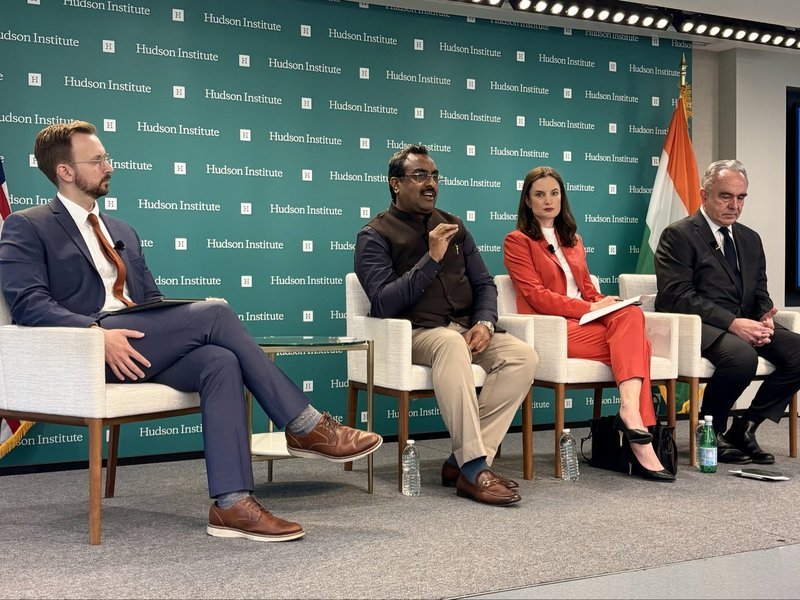
WASHINGTON, DC -India and the United States must rebuild “mutual respect, mutual sensitivity” and restore confidence in each other as their relationship faces a growing trust deficit amid geopolitical shocks, economic friction and global security crises, speakers said at the New India Conference hosted by the Hudson Institute, here.
The New India Conference, held on April 23, brought together policymakers, strategists and analysts to assess India’s evolving global role and the future of India-U.S. ties.
The high-level panel discussion said the partnership remains durable and strategically important, but is undergoing a difficult phase marked by misaligned expectations, slower momentum and visible stress across its strategic, economic and people-to-people pillars.
Ram Madhav, president of the India Foundation, said the relationship, though “very important” and “lasting,” is facing pressure at multiple levels.
“There is a big lack of mutual trust today. We need to build that trust once again,” he said, pointing to a sharp shift in perceptions compared to earlier periods of close political understanding.
Madhav said strategic alignment has weakened in recent years. “We had a great understanding of our geostrategic priorities… Today doesn’t seem so anymore,” he said, citing divergence over China and broader strategic clarity.
He said the economic pillar has also come under strain because of trade tensions and investment imbalances. “We are also facing net negative FDI from… the US on the economy,” he said, while expressing hope that an upcoming trade agreement could help stabilize ties.
On the Indian diaspora in the United States, Madhav said there was “a lot of anxiety, a lot of worries,” underlining the importance of people-to-people ties that have historically strengthened bilateral relations.
He called for recalibration based on “mutual respect… mutual sensitivity… and mutual interest,” adding that “it’s not enough to be goody goody about the things… it is important to really look at what is happening.”
Elizabeth Threlkeld, senior fellow at the Stimson Center, said the past year had effectively put the relationship through a “stress test,” but noted it had not “come to a screeching halt.”
She said cooperation continues in defense, energy, space and supply chains, even amid reduced high-level engagement.
Threlkeld added that strong economic ties, including major investments by U.S. technology firms, continue to provide “ballast” to the relationship.
She said India’s response to changes in Washington had been “remarkably measured and mature,” describing New Delhi’s outreach to other partners as “incremental calibration rather than any sort of fundamental shift.”
Threlkeld also said both countries often misread each other’s constraints. “Each side has a tendency to see the others’ limits as choices, but their own limits as necessities,” she said, calling for a candid reassessment of shared interests and more practical outcomes to reduce friction.
She identified immigration and visa uncertainty as important concerns affecting business and people-to-people ties, while adding that the shared democratic narrative underpinning the partnership has “less traction than it used to.”
Kurt Campbell, former U.S. Deputy Secretary of State, described the relationship as “the most important… for the United States in the 21st century,” but acknowledged rising unease.
“It is troubling… that we have to have a reminder around mutual respect,” he said.
Campbell said the current strain runs deeper than policy disagreements. “This has caused a deep hurt… a deep, profound hurt among Indian friends,” he said, adding that emotional and political factors are also shaping perceptions.
He said the relationship had advanced significantly over the past two decades, with many expecting it to become the “dominant relationship” of the century, making the current phase especially consequential.
Campbell highlighted the resilience of diaspora ties, recalling the rapid mobilization of Indian-American communities during the Covid crisis. He also stressed the need to expand education and technology partnerships, citing strong demand among Indian students and professionals.
At the same time, he warned that bureaucratic and strategic misalignment within the U.S. system continues to complicate engagement with India, particularly in defense structures spanning multiple regions.
The discussion also focused on the impact of ongoing global conflict on the Indian Ocean region.
Madhav said the expansion of conflict into the “entire Indian Ocean region” was “certainly a matter of big concern” for India, stressing the need for “negotiation” and “dialogue.”
Threlkeld said the crisis had exposed vulnerabilities in supply chains, energy security and maritime operations, and called for deeper cooperation in logistics, intelligence-sharing and contingency planning.
Campbell warned that the long-term economic and military consequences of the conflict would be “greater… than anyone is really ready to acknowledge,” particularly for the Indo-Pacific as U.S. resources shift away from the region.
Madhav also called for renewed momentum on initiatives such as the India-Middle East-Europe corridor and I2U2, the grouping of India, Israel, the United Arab Emirates and the United States, which he said have faced uncertainty in recent months.
Speakers broadly agreed that despite present strains, the India-U.S. partnership remains essential and requires sustained political attention, clearer alignment on priorities and renewed trust-building to navigate an increasingly uncertain global environment. (IANS)