It Is India’s Moment As Supply Chains Shift: Nisha Biswal
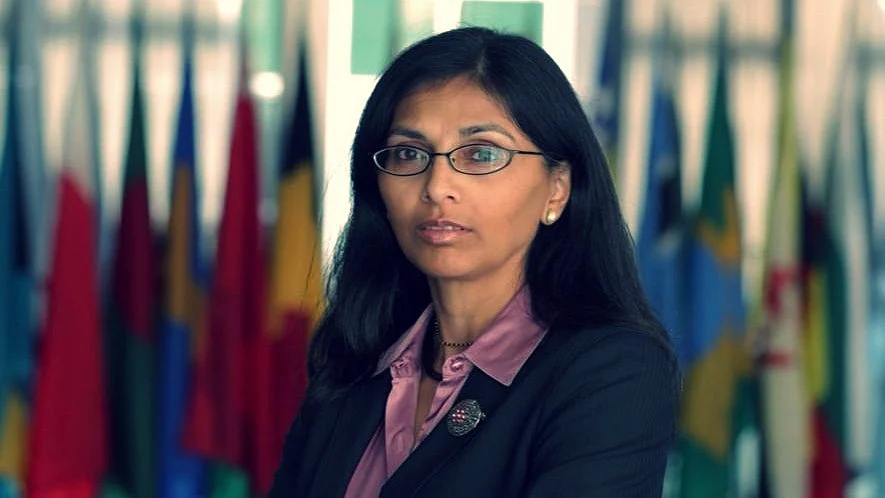
WASHINGTON, DC-India is emerging as a key player in the global realignment of supply chains as businesses seek to reduce dependence on China, former U.S. official Nisha Biswal said at a conference here.
Biswal, a partner at The Asia Group and former U.S. Assistant Secretary of State for South and Central Asian Affairs, said companies are rethinking business strategies amid geopolitical and economic uncertainty.
“There has been enormous progress,” she said, noting that U.S.-India trade has grown “from 50 billion… to… about 212 billion” even without a formal trade agreement. Companies are now asking “what does a de-risking from China look like,” she said, adding that India’s large domestic market and skilled talent pool are attracting global interest.
“It is India’s moment in the economic space,” Biswal said, pointing to the country’s scale, resilience and growth potential.
She said the U.S.-India relationship is expanding beyond strategic cooperation to include a stronger commercial focus, with growing attention in Washington on economic engagement and supply chain partnerships.
Biswal said a trade agreement between the two countries is likely, though not immediate, and may emerge first as a phased arrangement rather than a comprehensive deal. She identified energy, advanced technology and critical minerals as areas for deeper bilateral cooperation.
Biswal said global shocks, including geopolitical tensions and supply disruptions, are influencing economic decisions, while India continues to maintain growth momentum.
Other panelists said domestic reforms would be critical to sustaining India’s growth.
Hemang Jani, a public policy and governance expert at the World Bank, said India needs to address skills gaps and low workforce participation, describing them as “binding constraints” on growth.
Ashok Malik, partner at The Asia Group, said India had recalibrated its trade policy after earlier agreements exposed vulnerabilities. “That did cause a recalibration of approach to trade,” he said.
Richard Rossow, senior adviser at the Center for Strategic and International Studies (CSIS), said state-level reforms are vital because “States run the country,” citing infrastructure and regulatory issues that affect investment decisions.
The discussion took place during the New India Conference in Washington, where policymakers and analysts examined India’s economic outlook and U.S.-India ties.
Experts said the pace of economic reforms and deeper trade engagement with the United States will shape the next phase of India’s growth. (IANS)