Aashray Harishankar: Carrying A Musical Tradition Into The Future
By Fatema Baldiwala
There is something beautiful about watching tradition reinvent itself.
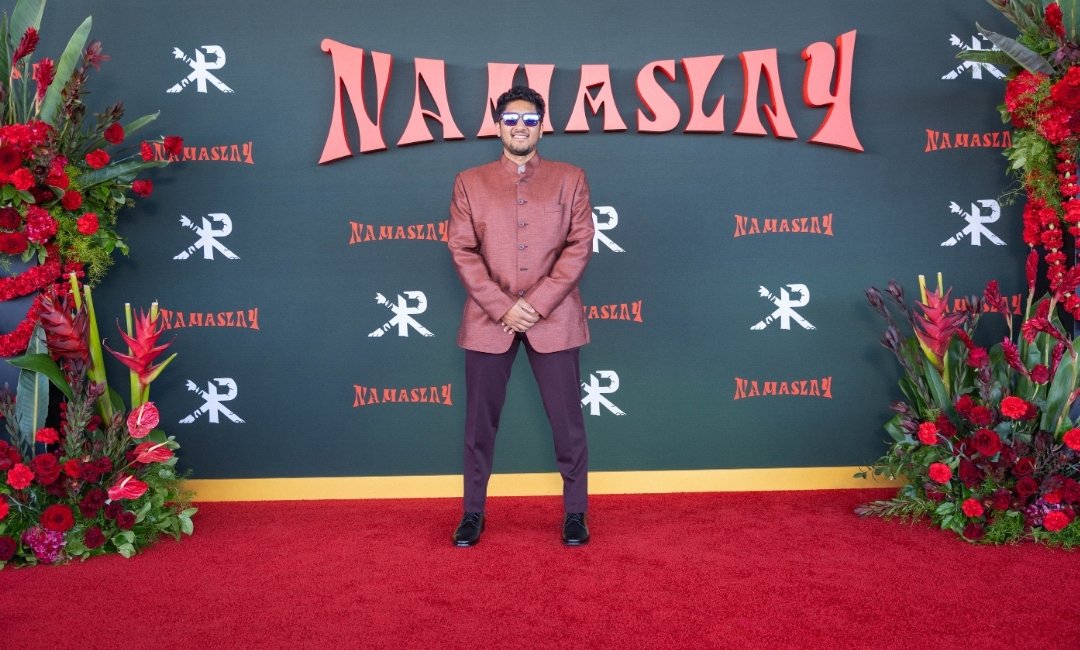
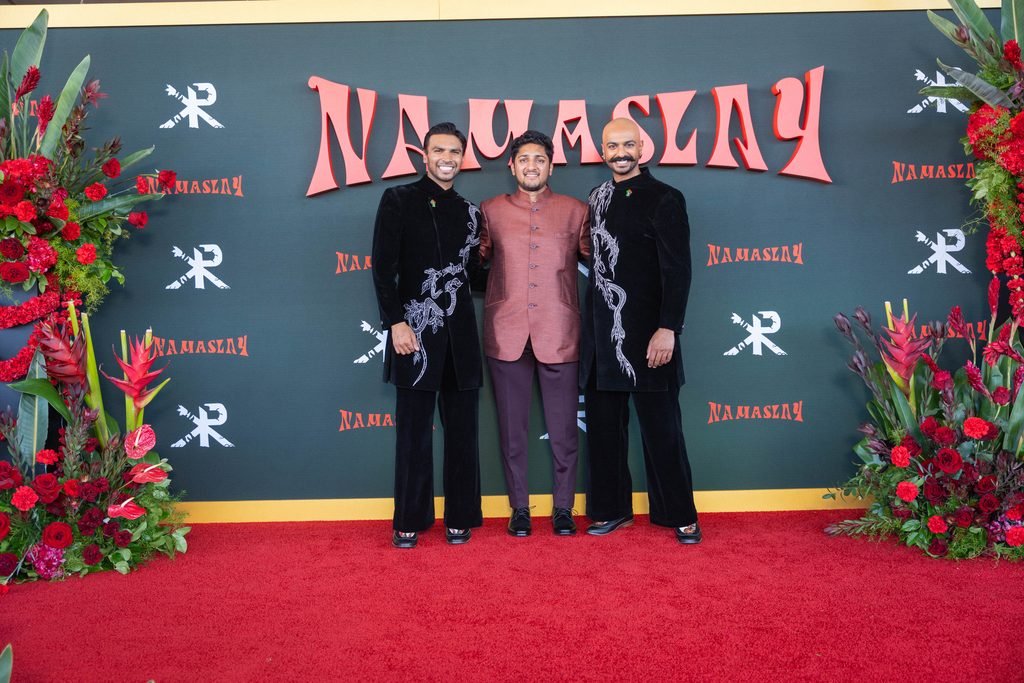
For Aashray Harishankar, music is not simply something he inherited from his family. He has taken it apart, experimented with it, and rebuilt it in his own language. His musical journey begins with Carnatic music, travels through jazz, R&B, popular music and music production, and eventually arrives on the cinematic canvas of ‘Namaslay,’ the new independent film directed by brothers Rish and Kanish Arhant-Sudhir.
Harishankar is the film’s composer and musical director, but calling him simply a “film composer” does not quite capture the breadth of his musical background. He is an emerging artist whose work represents an increasingly global South Asian musical identity – one that does not discard tradition in order to become contemporary, but carries tradition forward in a new form.
His artistic foundation was established at home. His mother, Ramya Harishankar, is a longtime Bharatanatyam dancer and teacher and the founder of Arpana Dance Company in Irvine. His father, Harish Murthy, founded Ektaa Center, a nonprofit cultural organization that has provided a platform for Indian and South Asian artists, musicians, dancers and performers. Harishankar grew up surrounded by the arts, with performances, workshops and visiting artists becoming part of the fabric of everyday life.
“I had a lot of exposure to that growing up,” he says.
That exposure was not limited to one form of Indian art. Carnatic music became his foundation, but Harishankar did not remain confined within its boundaries. He explored jazz, contemporary and popular music, eventually moving into music production and working across genres including R&B and film music. His musical education became less a straight line than a conversation between different traditions.
Perhaps the most intriguing part of that conversation is the instrument he has chosen to play for the past decade: the ROLI Seaboard, a futuristic, touch-sensitive keyboard that allows a musician to move between notes in ways that a traditional keyboard cannot.
For a musician trained in Carnatic music, that flexibility is particularly significant. Indian classical music does not treat the spaces between notes as empty territory. The movement between notes- the nuance, the ornamentation, the ability to bend and glide is fundamental to expression.
Harishankar has found a contemporary technological tool that allows him to explore that musical instinct.
He explained that the Seaboard allows him to play “in between the notes,” creating a fluidity more commonly associated with instruments such as the violin or the human voice. Instead of being limited to the twelve tones of the Western musical scale, he can explore the spectrum between them.
There is an almost poetic symmetry in that.
A musical tradition passed from one generation to another is not being preserved in a glass case. It is evolving.
That evolution becomes particularly evident in ‘Namaslay,’ where Harishankar’s music had to serve not merely as background but as part of the storytelling itself. Rish and Kanish describe music as a living, breathing element of the film – almost another character.
The directors had known Harishankar before ‘Namaslay.’ He was among the earliest collaborators to read the screenplay after they wrote its first draft in 2013. When the project eventually moved forward, their previous creative relationship made him a natural choice for the score.
The filmmakers have respect for his willingness to experiment. They described Harishankar as someone who “keeps the lab open”- a collaborator willing to entertain an idea before deciding whether it will work.
For Harishankar, that openness is part of the creative process. “There are no ideas that aren’t going to work,” was essentially his philosophy: try them, explore them, and discover what belongs.
That approach seems particularly appropriate for a film like ‘Namaslay,’ which itself exists at the intersection of cultures and genres. The film moves between comedy, horror, satire and South Asian cultural commentary. Its music therefore needed to inhabit a similarly expansive space.
The conversation eventually turned to artificial intelligence and its growing role in music. Harishankar acknowledged that AI can make music that sounds convincing. It can produce something functional, perhaps even something that listeners might mistake for human-created music. But he sees an important distinction between functional music and artistic expression.
For him, the future of music is not necessarily a battle between humans and machines. It is about understanding what makes art meaningful.
“I just think that people believe in other people first and foremost,” he said. “Humanity at the center.”
That belief may be the most important part of Harishankar’s musical journey.
He has inherited Carnatic music from one generation, absorbed the artistic influences of his parents, explored global musical traditions, embraced new technology and now creates music for film. Yet none of those influences has erased what came before. Instead, they have expanded it.
This is what cultural continuity can look like in the 21st century.
The tradition continues, but in a new musical form.
Harishankar is not simply carrying his family’s artistic legacy forward. He is adding his own voice to it.
And perhaps that is the real purpose of inheritance: not to reproduce exactly what we were given, but to take what our parents and teachers gave us, transform it through our own experiences, and leave something new for the generation that follows.