Taslima Nasrin Slams Book Bans
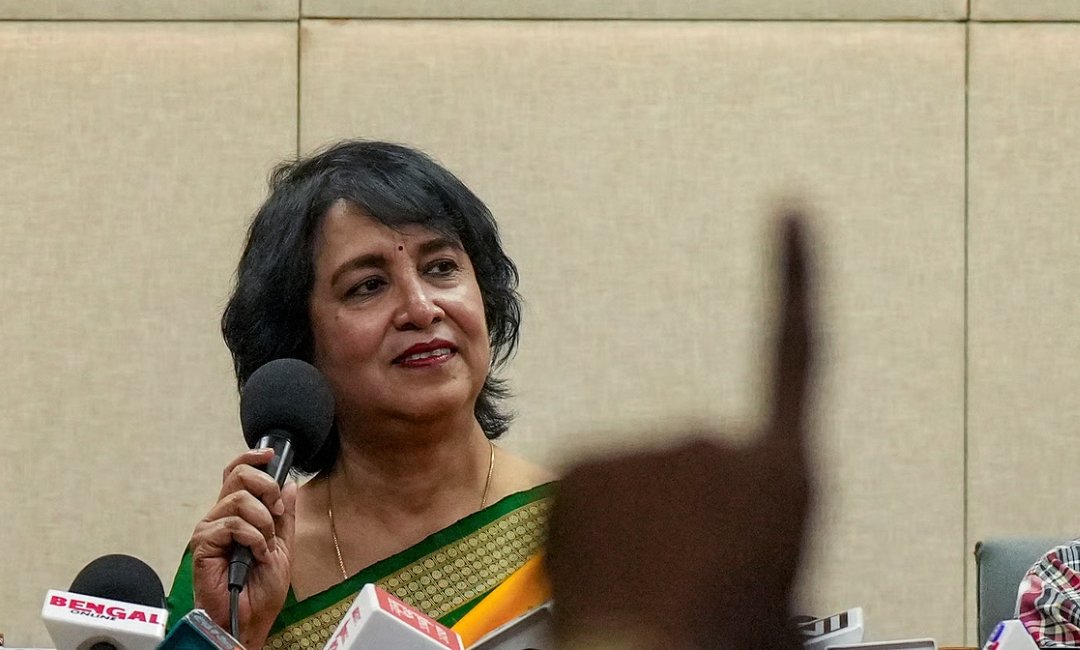
NEW DELHI-Bangladesh-born Swedish author and activist Taslima Nasrin has revived the debate over book bans and the repression of writers, drawing attention to the history of censorship as videos of vandalism at Left Front book stalls in West Bengal during the recent Durga Puja celebrations circulate widely.
While the vandalism at the Left Front’s book stalls has triggered a political row in West Bengal and the right wing BJP is widely blamed for the attacks. Nasrin argued that opposition to censorship should not depend on political allegiance.
“Protesting book burning, bans, or imprisoning or exiling writers shouldn’t depend on party colors. You don’t defend freedom of speech by demanding freedom for the books you like and censorship for the ones you don’t,” she wrote. She then took aim at the left wing who she has long tangled with.
“Banning books, burning books, silencing writers — isn’t that in the history of Communists? It is,” Nasrin wrote in Bengali in a Facebook post. “Sometimes it’s a party attack, sometimes a government ban, sometimes sending writers to labor camps, sometimes forcing them into exile. We need to keep track of that with the names of the country, party, rulers, and time. The list below isn’t complete, but there’s documentation for each incident,” she added.
Nasrin included the ban on one of her own works by the then Left Front government in West Bengal, then led by Chief Minister Buddhadeb Bhattacharjee, in her list of censorship cases. The government banned and confiscated the book, citing concerns over religious sentiments.The Calcutta High Court lifted the ban in 2005.
She also recalled events in November 2007, when Communist Party of India (Marxist) state secretary Biman Basu said that she should leave West Bengal if her presence threatened peace. Nasrin wrote that she was expelled from the state the following day.
Nasrin’s list included Russian writer Aleksandr Solzhenitsyn, who spent years in prisons and labor camps before being forced into exile for his criticism of Soviet rule. She also cited writers Varlam Shalamov, Osip Mandelstam and Yevgenia Ginzburg, who faced imprisonment or persecution under the Soviet system.
Among the books she listed as having faced censorship or suppression were Yevgeny Zamyatin’s ‘We’ and Boris Pasternak’s ‘Doctor Zhivago’. She also referred to writers Andrei Sinyavsky and Yuli Daniel, who were prosecuted for publishing satirical works deemed anti-Soviet and sentenced to forced labor.
“This happened long after Stalin’s death. The State’s oppression of writers did not stop just because Stalin was gone,” she wrote.
Nasrin also cited Czech writers Milan Kundera and Václav Havel as examples of repression under Communist rule. Kundera’s works were banned after the Soviet-led invasion of Czechoslovakia in 1968, and he moved to France in 1975. Havel’s plays were blocked from publication and performance, while his works were banned in schools and government libraries in 1971.
Turning to China, Nasrin cited Jung Chang’s ‘Wild Swans’, which traces three generations of women in her family against the backdrop of Mao Zedong’s rule and the Cultural Revolution. She said the book remains banned in mainland China.
Nasrin referred to Vietnamese writer Duong Thu Huong, whose novel ‘Paradise of the Blind’ was effectively banned under Communist rule. She said Huong was expelled from the Communist Party for advocating human rights and democratic reform and was imprisoned without trial in 1991.
In Cuba, Nasrin cited poet Heberto Padilla, whose poetry collection received an award in 1968 but was criticized by the organization’s leadership as “counter-revolutionary”.
Her list also covered book burnings during China’s Cultural Revolution, when Mao-backed Red Guards destroyed books and libraries, and book burnings by sections of Maoist groups in West Bengal around 1970-71. (IANS)