As Indian Americans Gain Political Clout, Civic Knowledge Still Uneven
India-West News Desk
NEW YORK, NY – A new nationwide study offers a rare empirical look into how well Indian Americans understand political developments in both the United States and India. The findings are drawn from the 2024 Indian American Attitudes Survey (IAAS), by the Carnegie Endowment for International Peace which was conducted online between September 18 and October 15, 2024, in partnership with YouGov. The survey included 1,206 Indian American residents—both citizens and noncitizens—and carries a margin of error of ±3 percent.
One of the key questions explored in the survey is how connected Indian Americans remain to Indian politics, especially across generations. The study assessed political knowledge through six factual questions—three focused on India and three on the U.S.
On Indian politics, just 39 percent correctly identified that the prime minister is selected by the party or coalition with a majority in the Lok Sabha. Nearly one-third (31 percent) mistakenly believed the prime minister is directly elected by voters, while 10 percent attributed the decision to the president and 4 percent to state legislatures. Seventeen percent said they didn’t know.
Knowledge levels were higher for the other two India-related questions: 73 percent correctly named Jawaharlal Nehru as the country’s first prime minister, and 88 percent identified Great Britain as India’s former colonial power.
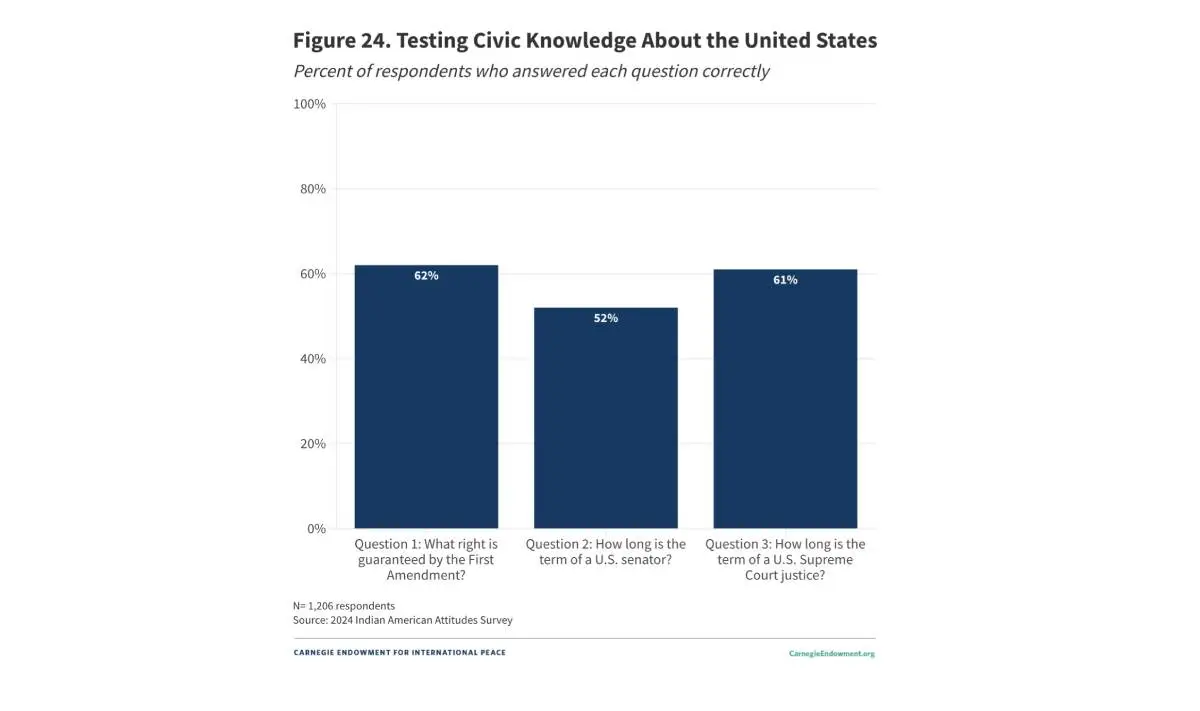
When it came to the U.S., Indian Americans showed similar knowledge gaps. Sixty-two percent knew that the First Amendment guarantees freedom of religion. Slightly more than half (52 percent) correctly answered that U.S. senators serve six-year terms, and 61 percent understood that Supreme Court justices are appointed for life.
The survey also found differences based on place of birth. Foreign-born respondents were more likely than U.S.-born ones to correctly answer all three India-related questions (36 percent vs. 27 percent).
However, when it came to U.S. political knowledge, 40 percent of U.S.-born respondents got all three answers right, compared to just 29 percent of their foreign-born counterparts. Foreign-born participants were also more likely to answer none of the U.S. questions correctly (22 percent vs. 10 percent).
The results highlight both the enduring ties many Indian Americans maintain with India and the informational challenges that can arise when navigating two political systems across generations.