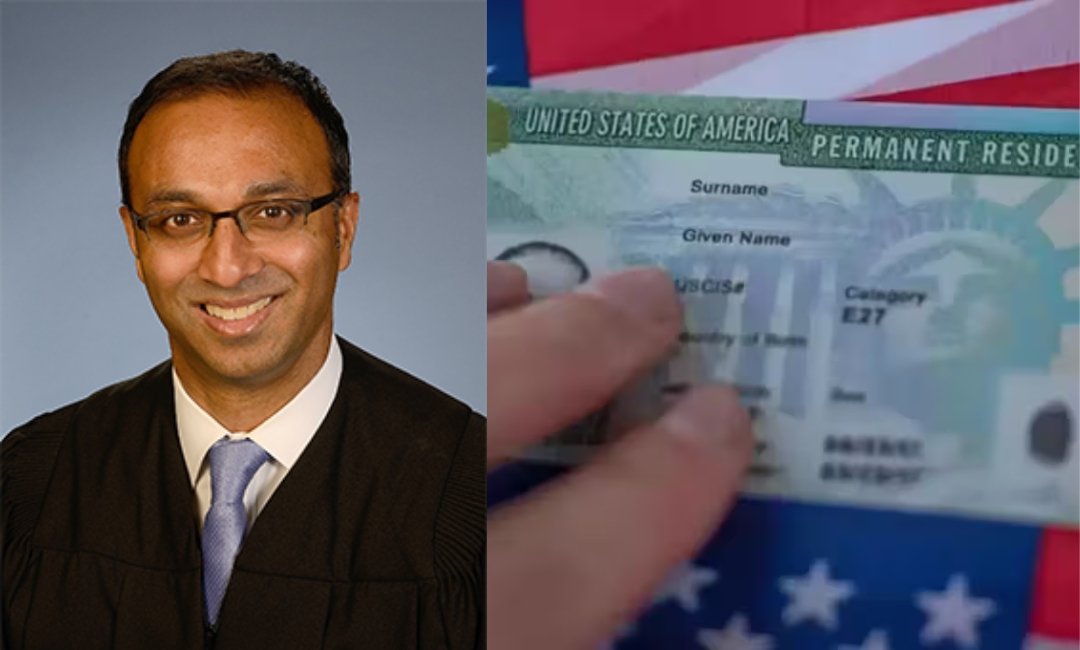
Judge Amit Mehta Rules State Department Green Card Freeze Unlawful
India-West News Desk
WASHINGTON, DC – U.S. District Judge Amit Mehta has ruled that the Trump administration’s policy freezing certain green card applications over public benefit concerns is unlawful, finding that the State Department exceeded the authority granted by Congress.
In a July 31 decision, Judge Mehta held that Secretary of State Marco Rubio’s public charge policy unlawfully stripped consular officers of their discretion to decide immigrant visa applications on an individual basis, according to Bloomberg Law.
The policy, adopted in January, has delayed immigrant visa processing for applicants from 75 countries, affecting primarily family-sponsored green card applicants as well as some employment-based applicants, Bloomberg Law News said. The administration argued the policy was intended to prevent immigrants who might become dependent on public benefits from receiving visas.
Mehta ruled that the Immigration and Nationality Act specifically assigns visa determinations to individual consular officers and does not permit the Secretary of State to predetermine those decisions through a blanket policy.
In his opinion, Mehta wrote that the State Department was doing “precisely what the INA prohibits” by controlling individual visa application determinations. He also concluded that the doctrine of consular nonreviewability, which generally shields visa decisions from judicial review, did not bar the lawsuit because it challenged the legality of a department-wide policy rather than an individual visa denial.
The case was brought by Brazilian national Newton De Moura Gomes, whose immigrant visa application through the EB-5 investor visa program was halted under the policy. He argued that the State Department violated the Administrative Procedure Act by unlawfully withholding a decision and adopting a policy contrary to federal law.
Mehta ordered the State Department to stop applying the public charge policy to De Moura Gomes’ application and to adjudicate it once a consular officer determines it is complete.
The ruling is one of several legal challenges to the State Department policy, which has also been contested in federal courts in New York and Washington, DC.