India’s Athletes Had To Overcome Housing, Transport, Travel Challenges To Compete In Asian Games
NEW DELHI-Two-time Asian Games medalist Rudrankksh Patil has spoken about the travel, accommodation and transport problems faced by the Indian shooting contingent during their journey to Japan for the Aichi-Nagoya Games.
Patil won silver in the 10m Air Rifle team event and bronze in the individual event. After his twin-medal performance, the shooter detailed the difficulties faced by the contingent, beginning with their journey from Bhopal to Japan via Delhi and Hong Kong.
“So, while we were going from Bhopal to Delhi and from Delhi to Japan via Hong Kong, it was a long travel for us from Bhopal to Delhi. Our flight had some issues, and we did an emergency landing in Jaipur,” Patil said.
“From there…. we went to Delhi. The next day, we had our flight. In the evening, we took the flight and came to Japan. It was an almost five-hour flight to Hong Kong, then six hours, seven hours halt in Hong Kong. And then again, from Hong Kong to Japan, it was five hours flight. And after reaching here, within five minutes, everything was cleared,” he said.
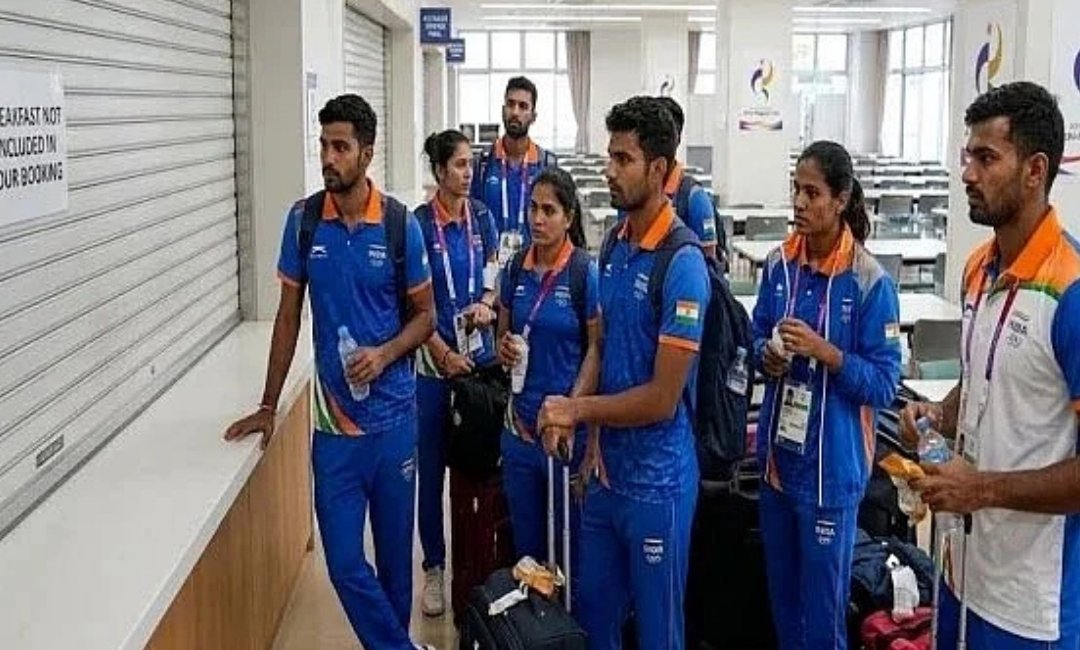
The contingent then faced a long wait for its bus at the welcoming center before reaching the hotel in the early hours of the morning. Patil said the hotel they had booked was not the one they were eventually assigned, leading to an altercation between the coaches and hotel staff.
“We went to the welcoming center. It took us three hours to wait for the bus over there. At 2 or 3 am, we started leaving for the hotel and reached there at around 3:30 or 4 am. After reaching the hotel, we realized that the hotel we had booked was not our hotel, we only had a couple of rooms over there, and that was supposed to be the best hotel.
“And our coaches were fighting over there that if you can give us the confirmation for the best hotel, then how are you shifting us to some other hotel?” he said.
Patil said the organizers had an accommodation arrangement in which one main hotel was connected to several other hotels, with rooms assigned based on availability. The Indian shooters were eventually accommodated at a hotel beside the main one.
“So, apparently, they had that village thing that one hotel was the main hotel and everything; every other hotel was connected to that hotel. And whatever room was empty, they were supposed to give us in that way. It did not work in the reservation way. So, it was quite disappointing to know that, but we had a hotel beside the main hotel.
“The rooms are very small. We cannot open our suitcases over here, but our coaches promptly decided that these rooms are too small to have them with double occupancy. So, the coaches gave every shooter single occupancy, and that made us stay much more comfortable. And this room is small, but it’s comfortable also. It’s cozy also. I love this room now,” he added.
The 2023 Hangzhou Asian Games gold medalist in the team event also highlighted problems with the buses provided for the contingent. He said the issue was later addressed with additional transport arranged by Indian authorities.
“Then the second issue was with the bus. Japanese are known for their time efficiency, but it was very difficult to see that the buses were coming on time. It took two hours to reach, rather than the 70 minutes, which they had promised, and it took two and a half hours to reach.
“So, that was a big problem. The next day, they solved it. The return bus issue was solved by providing us with more buses, but for going (to the competition), we had no guarantee because they did not know how many athletes were coming and how many are going to leave. The bus’s capacity was 50. So, our government provided us with private cars. So, every rifle, pistol and shotgun (teams), were given one car, or one car per day.
“And then whoever has a match will take the car so that no one misses the match, or even if the bus is delayed or due to any circumstance, the car will always be on time. So, again, yesterday was the women’s match (rifle women’s match); they took the car yesterday, and we had a match today; so, we took the car today.
“So, I think, you know, even though the things are not that good, but again, I like, you know, how it was handled, promptly handled and looking forward to how Japan is treating us, I would say the atmosphere is really good. The rooms look small, but this is part of their culture; as far as I am aware, they have small rooms, and the room has everything which a player would need.
Patil also praised Japan’s efforts to reduce food waste and conduct the Games in a sustainable manner.
“Other than that, Japan is always the first one to have a sustainable, ecological way of conducting tournaments, and that’s what they are doing. They ask us if we are going to have lunch or dinner or breakfast and they create the food items accordingly,” he said. (IANS)