Three Scientists Win NASA Innovation Grants
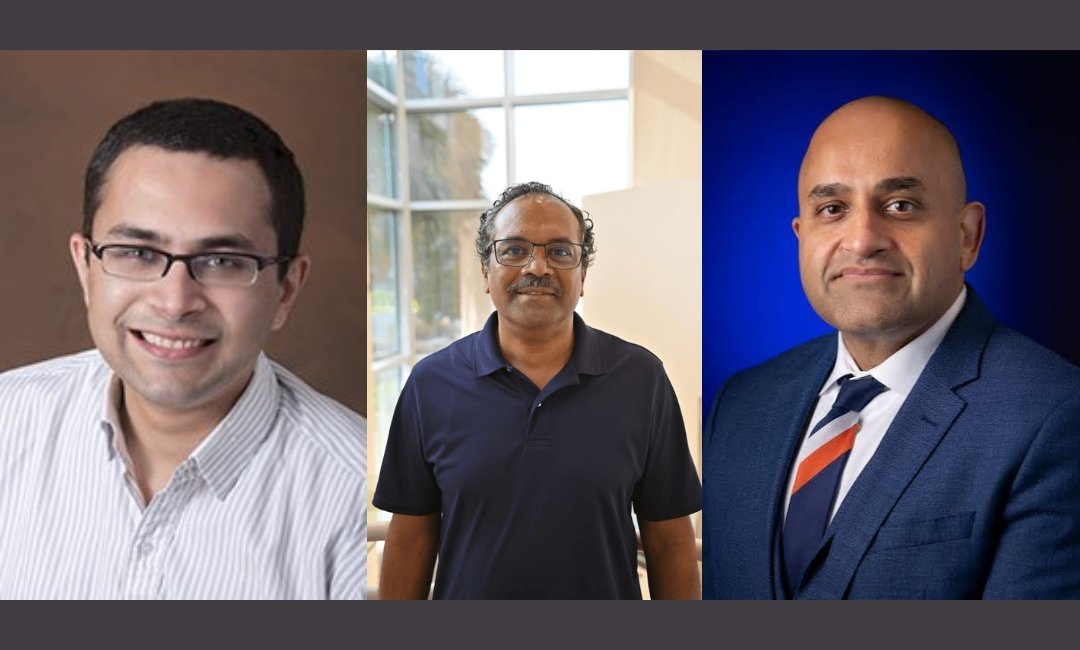
Photo: JPL, University of Central Florida & NASA
India-West News Desk
PASADENA, CA-Three Indian American scientists are among the 18 researchers selected by NASA for its 2026 Innovative Advanced Concepts (NIAC) Phase I awards, which support early-stage ideas that could shape future space exploration.
The selected researchers are Saptarshi Bandyopadhyay of NASA’s Jet Propulsion Laboratory (JPL) in California, Anish Damodaran of the University of Central Florida and A.C. Charania of Zeno Power Systems, Washington. Their projects cover climate science, advanced space observation and technologies aimed at helping astronauts during future lunar and deep-space missions.
Bandyopadhyay will lead DimSun, a study exploring whether a controllable cloud of dust in space could reduce the amount of sunlight reaching Earth. The concept will examine the feasibility of using spaceborne dust as a possible way to reduce solar radiation.
Damodaran’s project, PS21, focuses on using photonic technologies to improve submillimeter space interferometry, an approach that could enhance the capabilities of future space observatories studying distant objects in the universe.
Charania’s proposal, Extended Astronaut Radioisotope-EVA in Nighttime and Deep-space Icy Landscapes, aims to develop spacesuit heating technology using radioisotope heat sources. The concept is designed to help astronauts withstand the Moon’s nearly two-week-long nights as well as other extremely cold environments encountered during deep-space exploration.
NASA selected 18 concepts under this year’s NIAC Phase I program, awarding a total of $3.2 million. Each project will receive up to $175,000 for a nine-month feasibility study. The concepts are not official NASA missions.
Other selected projects include technologies for exploring lunar lava tubes, extending the life of scientific instruments on Venus, studying Saturn’s rings, collecting samples from planetary rings, powering interstellar spacecraft, mapping continents on exoplanets, observing black holes, detecting gravitational waves and improving space debris monitoring.
Phillip Williams, NIAC’s acting program executive, said the program helps identify ideas that could one day support future space missions.
“Every innovation, every leap in technology, starts with a seed of an idea,” Williams said. “The NIAC program allows NASA to germinate those seeds and determine if there’s something that could be grown to benefit future space missions and our nation’s aerospace economy.”